Most small and medium-sized companies have the same problem, and almost nobody deals with it.
Most small and medium-sized companies have the same problem, and almost nobody deals with it.
You have a good product. You have happy customers. But when someone googles in the evening a problem you can solve exactly, they find your competitors, portals and forums. Not you. Because your website has five pages that haven't changed since launch.
It isn't your laziness. It's maths. To be visible on Google, you need to publish content regularly on what people search for. A copywriter costs around two thousand per article. An agency tens of thousands a year. And you don't have time for it yourself, because you're doing your own job. So nothing gets written, and the company is invisible on the internet.
For a few of our clients we solved this problem. We built them a machine that writes content for them. We call it SEO Engine.
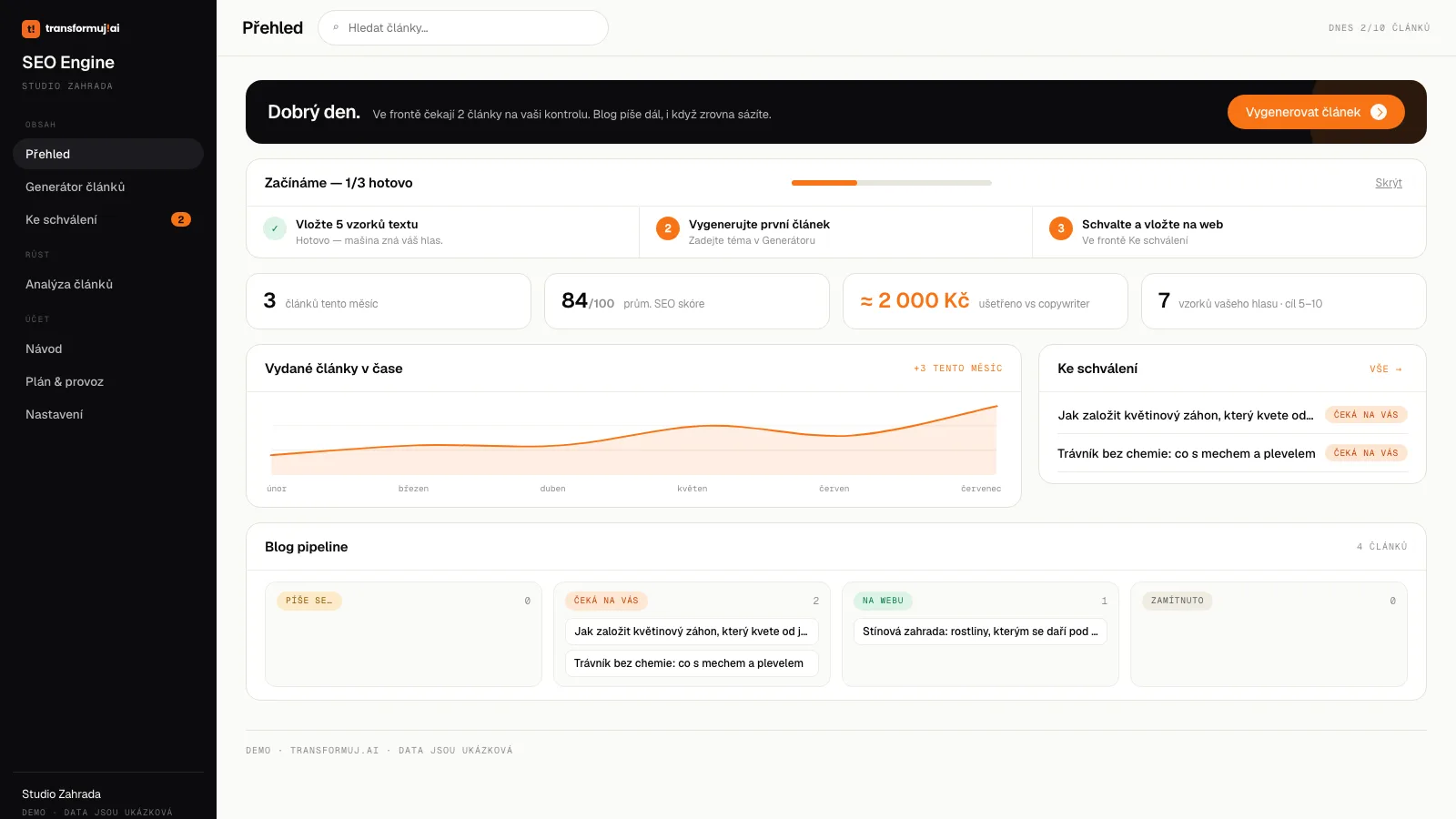
What it looks like for the owner: one button
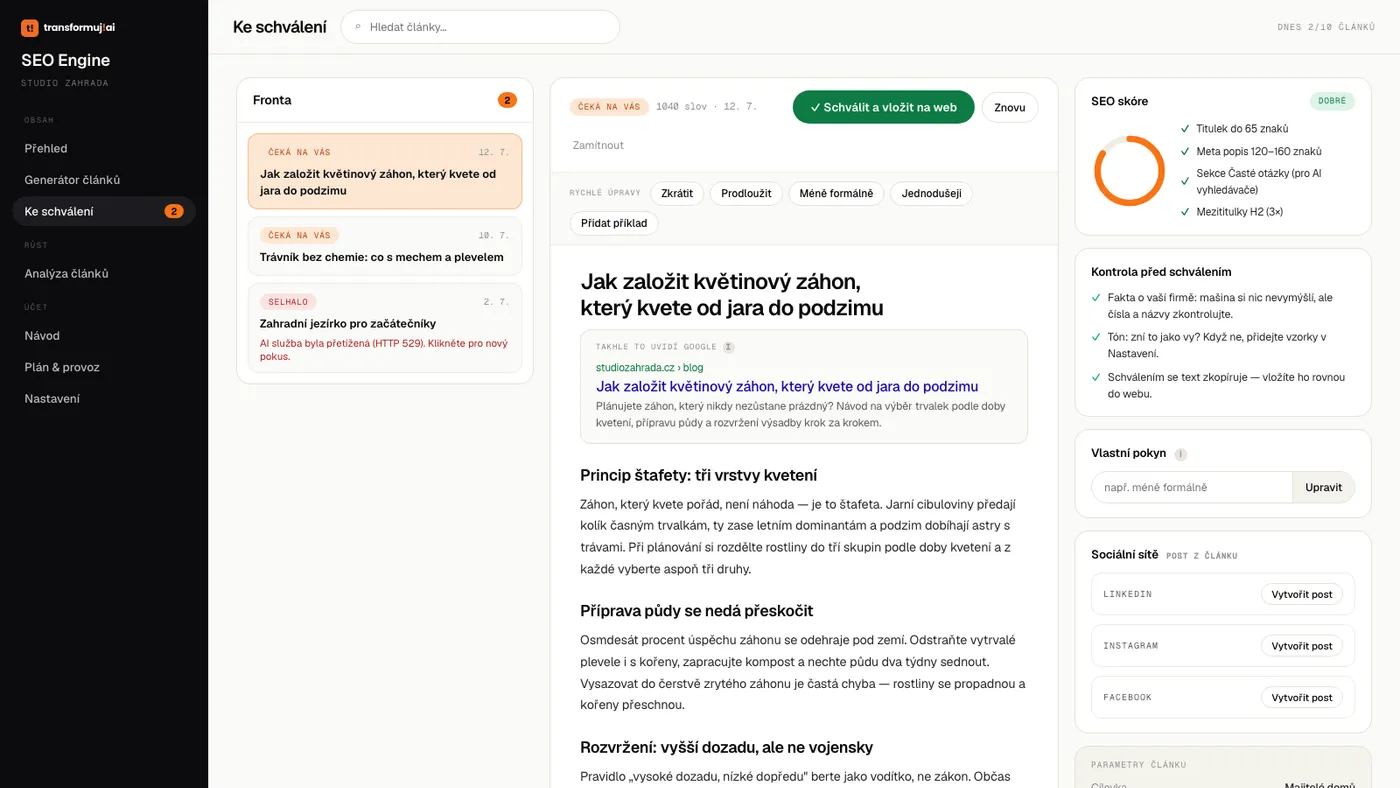
The whole control is deliberately primitive. You open an overview where finished articles are waiting for you. You read them. And you either click Approve, or write in one sentence what to change (“make it shorter”, “less formal”). The approved article publishes itself on your website.
That's all. No dashboards with fifty charts, no training, no new system you have to learn. Ten minutes a week over coffee, even from your phone.
That simplicity isn't an accident, it's the hardest part of the whole product. A company owner doesn't need another tool. They need things to happen without them, and just to keep the final word. That's why all the complexity runs in the back, where you don't have to touch it.
What runs in the back, explained in human terms
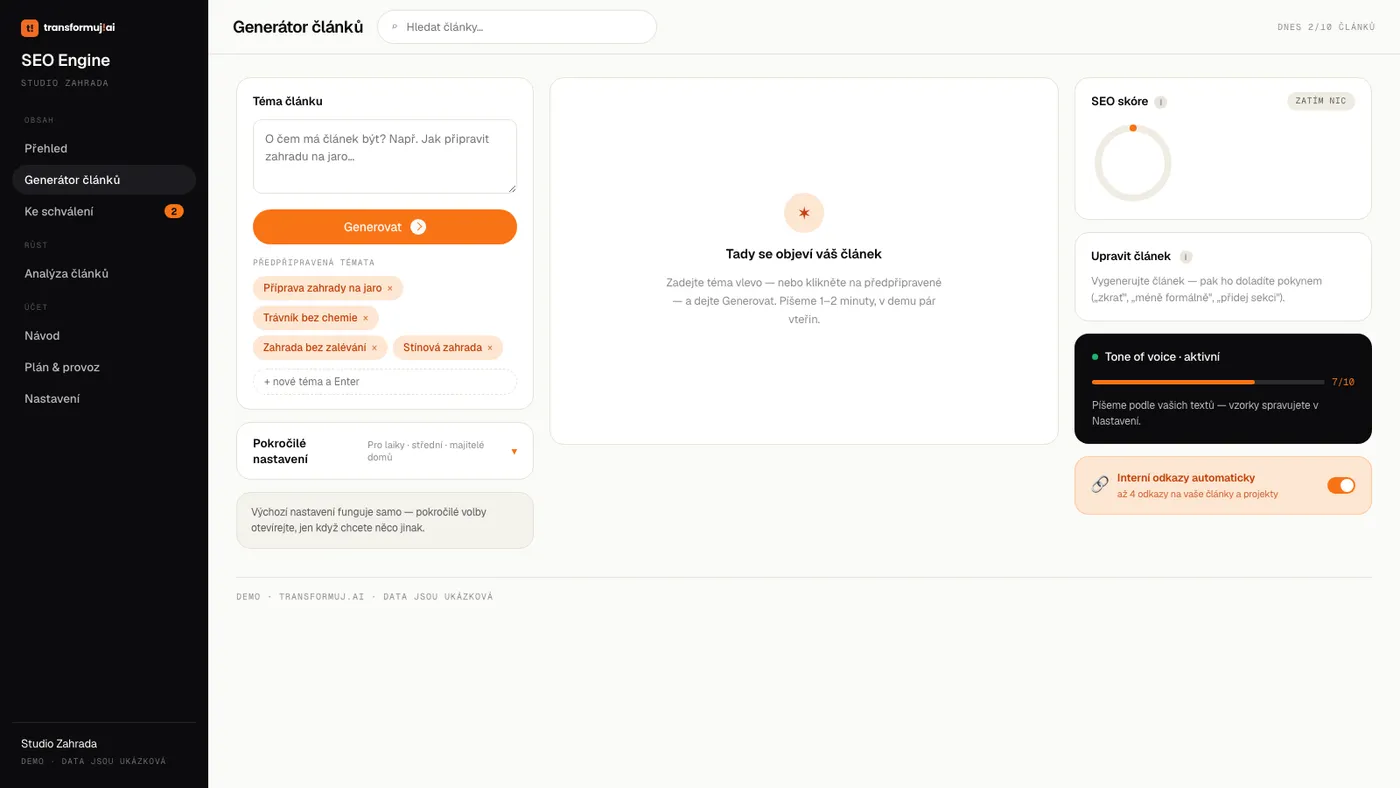
1. The machine knows your voice. At the start we feed it the texts you already have: website, quotes, emails, anything you've ever written. From that it learns how you talk. Articles then sound like you, not like a robot or an average of the internet. This is a fundamental difference from someone having ChatGPT write an article.
2. The machine knows what people search for. Topics aren't invented at a desk. They come from what your customers actually type into Google and what they ask. A tradesman gets an article “how much does renovating a concrete floor cost”, an e-shop “how to choose the right size”, a manufacturer “why material cracks in the warehouse in winter”. Each article is an answer to a real question from a real customer.
3. The machine checks itself, but doesn't publish itself. Every article goes through a check: readability, structure, keywords, links to real pages of your website. And then it waits for you anyway. The last word is always a person's. That isn't a weakness, it's insurance. Nothing you haven't seen ever goes out to your website.
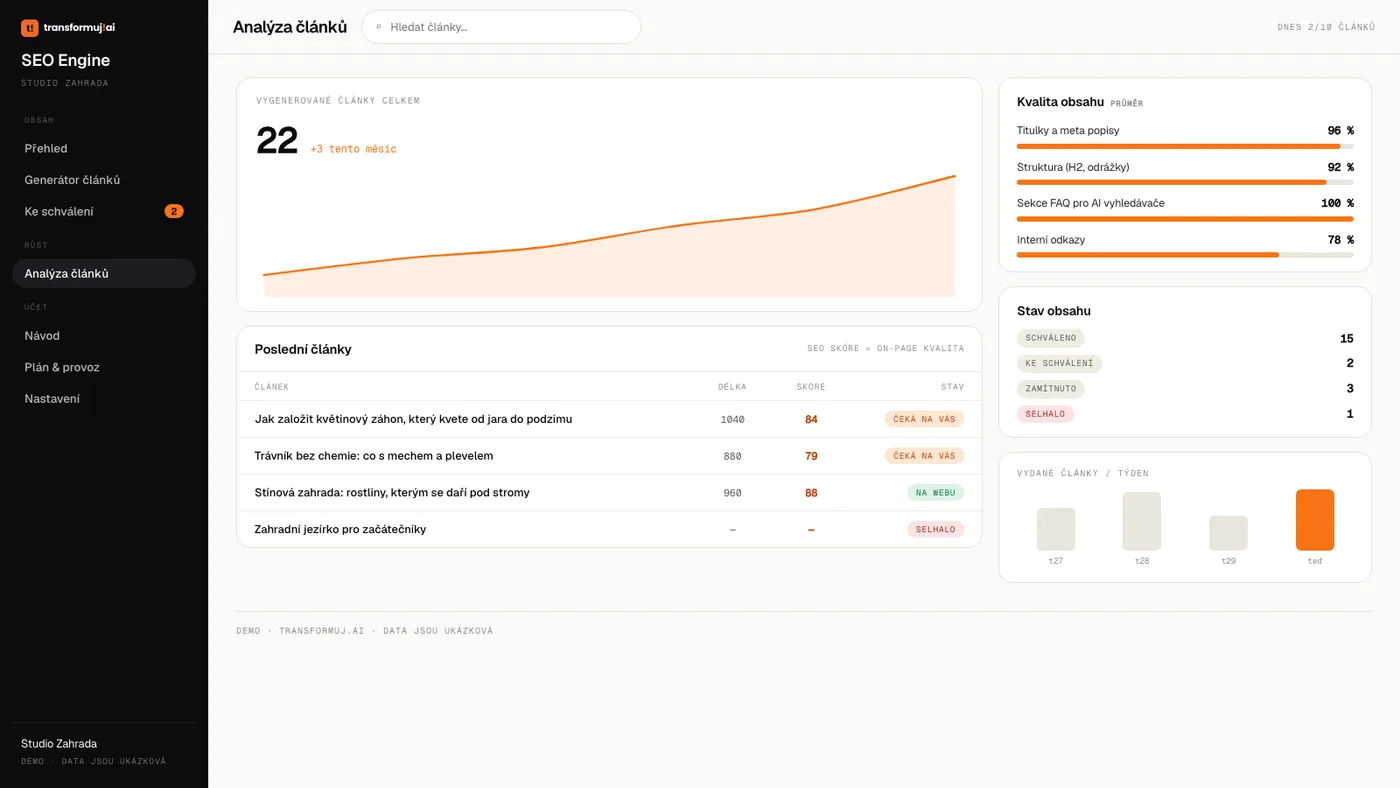
4. And it's measured. You see how many articles came out, what people read and where they come from. No impressions, numbers.
Why this is suddenly possible
Just two years ago this would have been a service for tens of thousands a month, because people would have done it by hand. Today language models can write a quality expert text at a cost of a few euros. Literally: an article for which you would pay a copywriter two thousand costs a few euros to produce. This isn't about skimping on quality. It's the same shift as when the computer replaced the printing press: the same output, a fraction of the cost.
And there's one more thing that isn't talked about much yet. People are ceasing to ask only Google. They ask ChatGPT and other AIs: “advise me who in the Czech Republic does X.” The AI answers based on what it reads about you. A company without content doesn't exist for it. Whoever publishes expert, structured texts, the AI can find and recommend. This is called GEO, and it's the reason content is ceasing to be marketing and starting to be infrastructure.
For the techies: how it is built
Tone of voice corpus: the client's texts serve as style samples, generation runs against them, not against a generic model. That's why the output holds the voice.
A generation pipeline with checks: topic proposal, outline, text, SEO score (structure, keywords, readability), meta descriptions, internal links validated against the real site map, FAQ blocks for citability in AI answers.
Approval queue: states being written, awaiting approval, on the website, rejected. Editing by an instruction in natural language, not by editing prompts.
Publishing: the approved article is written straight into the client's website, statically, so the speed of the website stays untouched.
Economics: model orchestration by task, routine on cheap models, the expensive model only for the plan and the final check. That's why those costs are on the order of euros.
“Why don't I just write it in ChatGPT?”
The most common question, and a perfectly fair one. I'll answer straight: you can. Claude and ChatGPT both write a decent article. I write with AI daily and it's a great tool. But between “I can have an article written” and “my website publishes content every week that brings in customers” there is a chasm, and 95% of attempts die in that chasm.
1. A chat requires you. The Engine doesn't. In a chat you have to, every time: sit down, come up with a topic, write the brief, read the output, fine-tune it, copy it to the website, add headings and captions, publish. That's an hour of work, and you have to do it this week, next week and in half a year too. Hand on heart: who of us can keep doing this every week for two years? Exactly. Content doesn't work because it's hard to write. It doesn't work because it's hard to keep writing. Discipline is the product, not the text.
2. A chat doesn't know you. It starts from zero every time. You write “write an article about humidifying halls” and get the average of the internet: generic phrases anyone could have written about anyone. The Engine has this set up once and for all: your voice, your knowledge, your price lists, your references.
3. Text from a chat is not an article on a website. The finished text is about half the work. What remains: the structure of headings, a meta description for Google, internal links to your pages (a chat makes links up, the Engine takes them from the real map of your website), FAQ blocks for AI search engines, uploading to the content system, publishing.
4. A chat has no feedback. You write ten articles and don't know which one works. The Engine measures: people read this article, enquiries come from this one, write more in this direction. Content without measurement is shooting in the dark.
So yes, you can write one article in ChatGPT. A content machine that keeps the pace, voice and quality for two years without you, you can't write in a chat. It's the same difference as between “I can cook dinner” and “I run a restaurant”.
Straight talk: what it won't do
It wouldn't be me if I didn't add an honest disclaimer. SEO Engine won't save a bad product or a dead company. Search results grow over months, not days, that's just how it goes on Google. And the machine needs your input at the start: texts, knowledge, a few hours of time, to learn your world. Whoever expects a miracle by Friday will be disappointed. Whoever lasts two quarters has a content machine that competitors take years to catch up with.
Who it makes sense for
E-shops: buying guides, comparisons, how-tos. Content that sells even when you aren't paying for ads.
Services and trades: answers to the questions a customer googles before they call someone.
B2B and manufacturing: expert texts on the problems your customers are solving. In fields where nobody publishes, a few articles can take over an entire topic.
What you ask most often
Won't Google tell that AI wrote it? Google officially says it doesn't penalise AI content, but low-quality content. It punishes generic texts without value, and it doesn't matter whether a robot or a cheap copywriter wrote them. Our content stands on your real knowledge, answers real questions and goes through human approval.
Won't it write nonsense? The machine works from your materials, not from imagination. Every article also goes through checks and above all: nothing goes to the website without your approval.
How much of my time will it take? A few hours at the start: you supply texts, we go through your field and topics. Then roughly ten minutes a week for approving.
How soon will I see results? Honestly: months. The first movement in search usually within 3 to 6 months, noticeable results within 6 to 12. Whoever promises you first place on Google in a month is lying.
Whose is the content, and what if I quit? Yours. The articles are on your website, on your domain, in your ownership.
Does it work in my field? It works everywhere customers search on the internet. And paradoxically it works best in “boring” fields where nobody publishes. There, twenty good articles can take over the whole topic.
Conclusion
Content has always been the cheapest marketing with the longest lifespan. But small companies never had the time or people for it. That has just changed. The machine writes, you approve, the website works. Even while you sleep.
The article was first published on LinkedIn. Original article on LinkedIn