A capable intern can connect AI to company data in an afternoon. And that is exactly why most Czech companies that have adopted AI can't demonstrate a return.
A capable intern can connect AI to company data in an afternoon. And that is exactly why most Czech companies that have adopted AI can't demonstrate a return.
Those two sentences are more connected than they seem. When something is easy to connect, everyone connects it, nobody thinks it through, and three months later it's a dead folder. I've been in IT, with breaks, for 20 years and gone through hundreds of projects, and I keep seeing this pattern.
That's why at Transformuj.ai we built Claude Cowork, our AI colleague for companies, the other way round. First months of thinking and testing on our side, then one day of rollout at your place.
Where a toy and a colleague part ways
A generic chatbot is like a new employee without training. It can do something, but it doesn't know what your offer looks like, what the priority is at your place and who you address formally. So people stop working with it and you have an expensive icon on your desktop.
At rollout, Claude Cowork gets three things that a plain connection doesn't have: your processes written down as skills, rules on what it may and may not do on its own, and an economy that watches how much its work costs. Only this trio turns a model into a colleague.
Skills: where your hours flow away
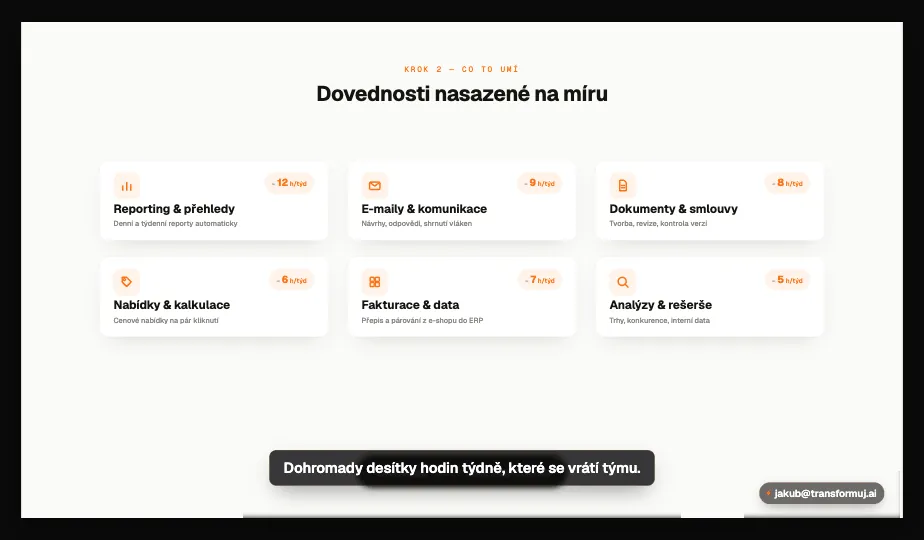
Before the rollout we go through where the team spends time on routine and put the skills together accordingly. Typically: reporting (saving around 12 hours a week), emails and communication (9 hours), documents and contracts (8 hours), invoicing and data matching (7 hours), quotes and calculations (6 hours), analyses and research (5 hours).
None of those items sounds earth-shattering. That's deliberate. Routine never sounds earth-shattering, it just eats half the week.
Rules: a lesson from a fresh attack
In July 2026 a study came out (Seoul National University, UIUC) that described a new type of attack on AI agents, Agent Data Injection. The attacker doesn't change the commands, they forge small details: the name of an email sender, the label on a button on a web page. The agent believes them and clicks “Buy” instead of “Read more”. All the large models tested were vulnerable.
What follows for you? That an AI colleague must never carry out actions involving money on its own. With Cowork this is the rule: payments, sending a contract and similar steps are always confirmed by a person. AI is a turbo, not an autopilot. Whoever sells you full automation without human control isn't selling you a system, they're selling you a risk.
Economics: why not everything goes to the most expensive model
The second thing you can't see from outside: which model works when. Simple sorting and extraction run on a cheap model, where a thousand runs cost only euros. A complex document or a judgement call goes to a stronger model, which is more expensive but saves a day of work. We choose by numbers, not by what sounds smartest. You can see it on your invoice.
What falls out at the bottom: the numbers
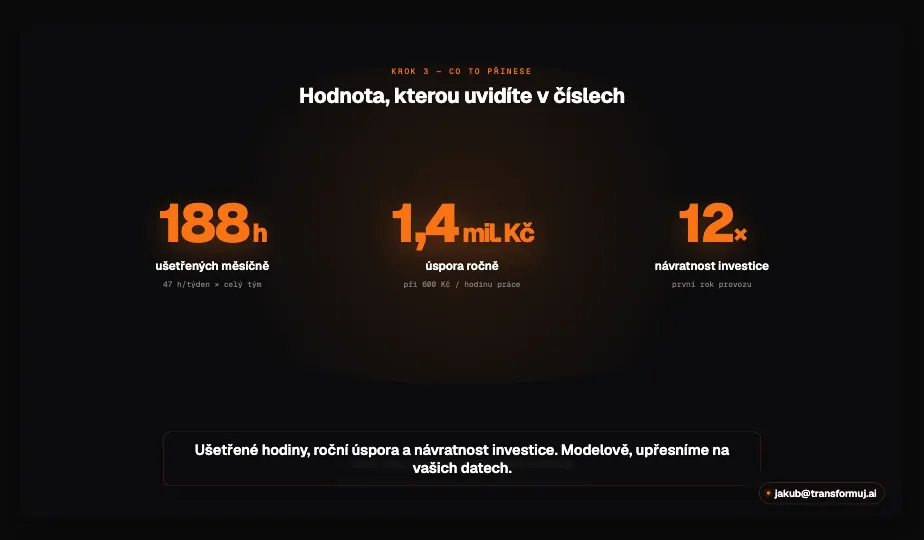
A model example for a whole team: 47 hours a week, 188 hours a month. At a rate of 24 EUR per hour of work that is roughly 56 000 EUR a year and a return of around 12× in the first year.
It's a model calculation and take it exactly that way. We calculate the real numbers on your data, and if they don't make sense, we'll say so straight away. We don't guarantee, we measure.
And that one day?
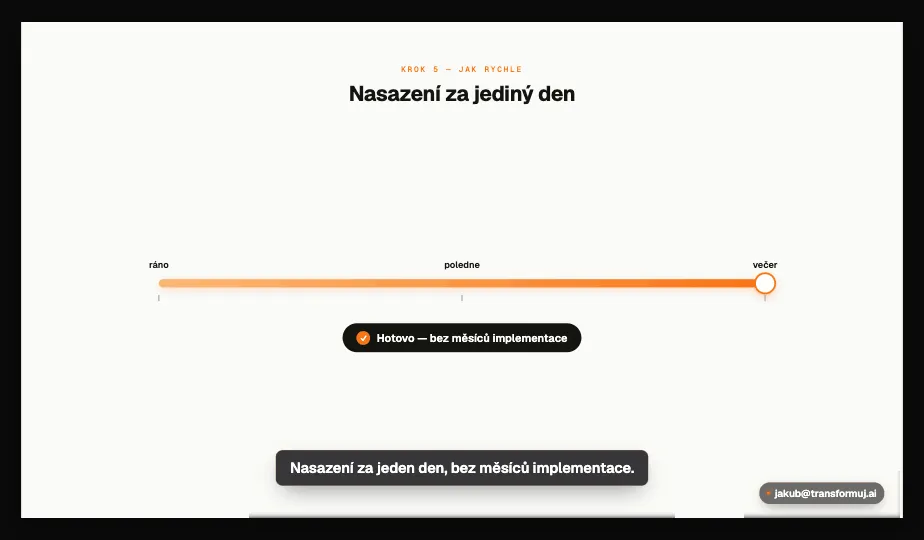
Morning: access and connecting the tools. During the day: tuning the skills with your team. Evening: operation.
Our team has over 10 000 hours with AI and each of us at least 10 years in IT. The speed isn't a trick, it's the result of preparation.
Frequently asked questions
How is this different from the ChatGPT we already have in the company? A generic chat knows nothing about your processes and everyone uses it differently. Cowork has your procedures written down as skills, clear rules on what it may do on its own, and a connection to your tools. That's why the team really uses it even after three months.
Is it safe to let AI at company data? You define the access and we set it up together on the first day. Critical actions, payments or sending, are always approved by a person. We account for attacks like forged data in the design, not after an incident.
How many hours will we really save? The model example shows 188 hours a month for a team, for you we calculate it on real processes before the rollout. From the first week we then measure the savings, numbers, not impressions.
Does our team have to be able to prompt? No. The skills are set up so that people give work in normal language, as to a colleague. Training the people who will work with it most is part of the rollout day.
What if our processes change? Skills can be adjusted continuously, it's a record of rules, not concreted-in software. A system without maintenance is a dead folder, which is why we look after the colleagues we deploy even after launch.
The article was first published on LinkedIn. Original article on LinkedIn